

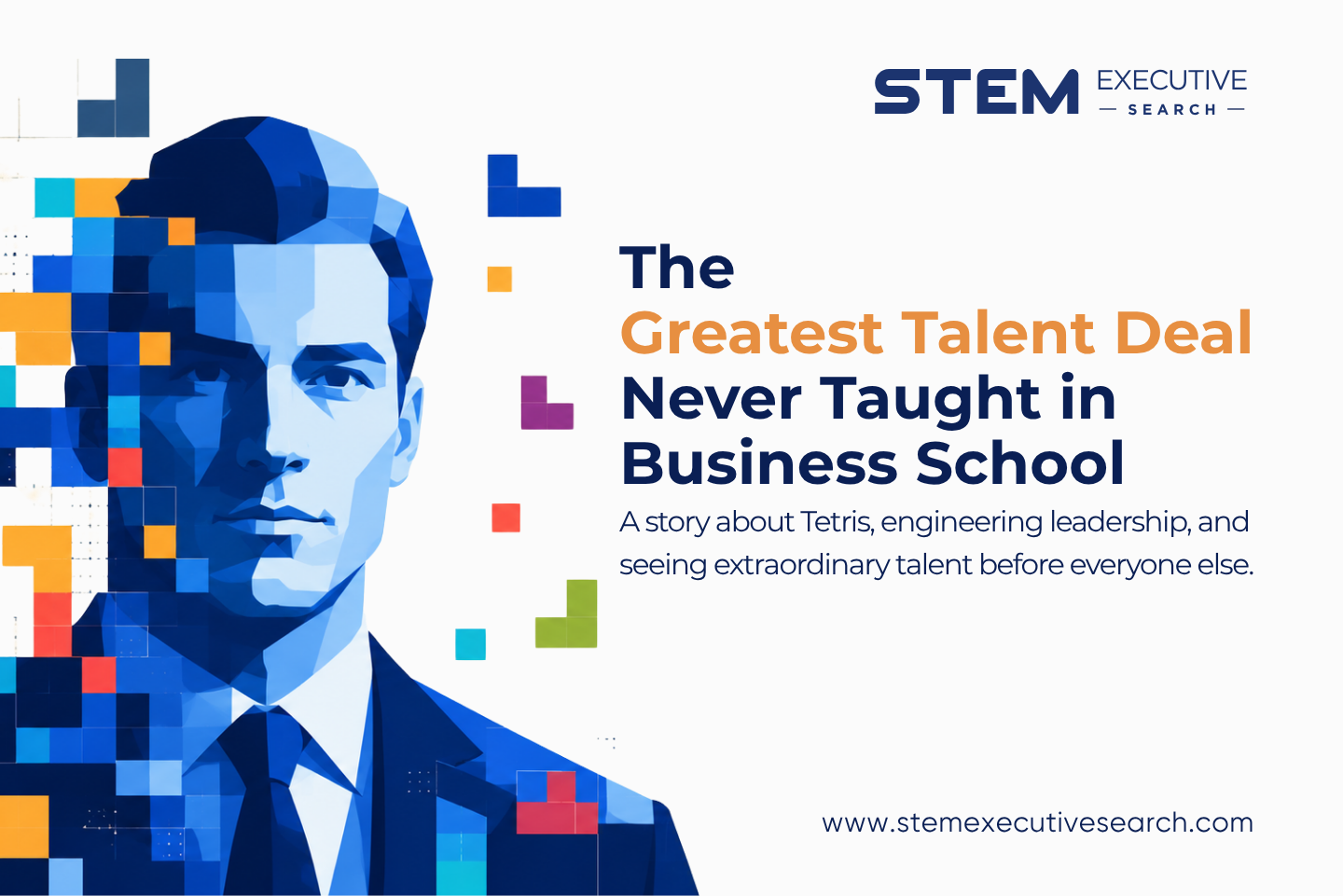
How the story behind the world’s most-played game holds the ultimate masterclass in cross-border conviction, creative courage, and the art of betting on the right person at exactly the right moment.
If you haven’t watched Tetris (streaming on Apple TV+), here is the short version:
In 1988, a Dutch game designer named Henk Rogers walked into a trade show in Las Vegas—not to change the world, but to sell his own modest game. Then, across the hall, he spotted a Soviet puzzle game running on a demo screen. A few falling blocks. A simple grid. Something clicked.
He didn’t just want to distribute it. He was convinced that what he was looking at was going to reshape human entertainment permanently.
What followed was not a boardroom deal. It was a Cold War thriller featuring corporate rivals, bureaucratic walls in Moscow, and a high-stakes race to secure rights that arguably no private citizen should have been able to acquire. He won, changing the course of gaming history.
But the real lesson isn’t about the game. It’s about seeing talent before anyone else does.
Seeing the Genius Behind the Framework
When Henk Rogers flew to Moscow on a tourist visa to meet the creator of Tetris, everyone around him thought he had lost his mind. He had mortgaged his home to fund the endeavor and was competing against powerful global media magnates.
Yet Henk saw something others missed: Alexey Pajitnov.
Alexey was a software engineer at the Soviet Academy of Sciences. He had created Tetris on a basic Electronika 60 computer in 1984, originally just to test the limits of the hardware. The Soviet state owned the rights to everything he produced; he hadn’t earned a single rouble from his creation.
Henk didn’t just negotiate for the licensing rights. He made it his personal mission to ensure Alexey was properly recognized, rewarded, and eventually brought to the United States. The two co-founded The Tetris Company together—a partnership that has stood for over three decades.
For modern organizations in deep tech, advanced manufacturing, and Global Capability Centers (GCCs), this holds a profound talent acquisition lesson.
4 Lessons the Tetris Story Teaches Engineering Leaders
Critical Capabilities Are Hidden Behind Uncommon Borders
Alexey Pajitnov built one of the most elegant problem-solving frameworks in human history inside a rigid institution, on a machine most modern engineers wouldn’t recognize.
In today’s global landscape, the most transformative engineering minds are rarely where the mainstream market is looking. They are often in second-tier cities, research labs, or emerging R&D hubs. The organizations that find them first don’t wait for generic CV platforms; they actively map for raw capability.
True Conviction Looks Like Irrationality Until It Wins
By conventional standards, Henk Rogers had no business being in that Moscow negotiating room. His advantage was not massive capital; it was absolute certainty. He had played the game, understood its impact, and refused to let rational caution override what he saw clearly.
The leaders who build industry-defining engineering teams share this quality. They don’t hire simply to tick off a checklist. They back a professional because they can spot execution capability before the broader market has priced it.
The Deal You Close Matters Less Than the Trust You Build
Henk Rogers could have walked away once the licensing rights were secured. Instead, he honored his relationship with Alexey.
In technical workforce acquisition, the difference between a standard placement and a long-term legacy is exactly this. The right senior or specialized hire doesn’t just fill an immediate skill gap; they elevate the institutional capability of everyone around them.
Complexity is a Filter, Not a Barrier
Every competitor initially walked away from the complex Soviet licensing process because it was deemed too risky and uncertain. Henk leaned in.
Particularly across GCCs, cross-border engineering mandates, and specialized deep-tech verticals, operational complexity is the precise filter that keeps your competitors out. The organizations with the patience and specialized expertise to navigate these talent pools properly are the ones that secure the game-changing players.
Sourcing Your Game-Changing Technical Workforce
Henk Rogers won because he was willing to look deeper than anyone else, identifying the human innovator behind the product rather than just looking at a transactional opportunity.
At STEMExecutive Search, that is the methodology we apply every day.
We map elite technical and scientific talent across sectors where capability is scarce and the stakes of an incorrect hire are exceptionally high:
- Deep Tech & Automation
- High-Precision Manufacturing & Automotive
- Aerospace, Defence, and Core Infrastructure
- Global Capability Centers (GCCs) & Tech R&D Hubs
Whether you need a specialized developer to take a prototype to precision scale, or a strategic leader to steer an entire engineering unit across any experience level—we find the hidden architects your organization hasn’t met yet.
🌐 Partner with STEMExecutive Search Today to build your next-generation team.
Inspired by Tetris (2023), directed by Jon S. Baird, streaming on Apple TV+.